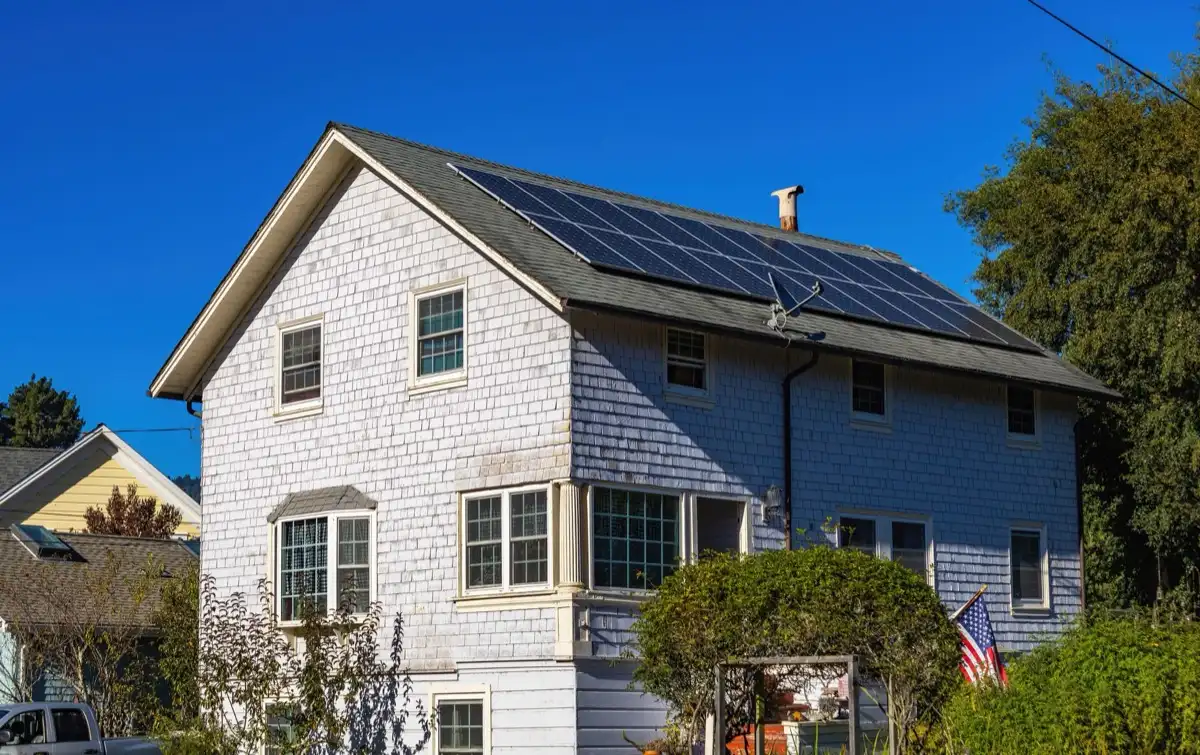
Shingle is a way of laying a roof, not a material. Small units, overlapped in courses, each covering the joint below, water shed from one to the next. Asphalt does it. So do cedar, slate, clay, concrete, steel and molded polymer — six materials, one method.
Which makes this two questions: the taxonomy, and the shorter list of what your house is allowed to carry.
The whole menu, in one table
Weight against architectural asphalt, because absolute pounds drift and ratios do not.
| Covering | What it is | Weight vs architectural asphalt | What decides it |
|---|---|---|---|
| 3-tab asphalt | One layer, cut out | Lighter | Wind class, and whether you can still buy it |
| Architectural asphalt | Two layers laminated | Baseline | Nothing. It is the default for a reason |
| Luxury / designer asphalt | Thicker laminate | Somewhat heavier | Slate's look at asphalt's weight |
| Wood shingle | Sawn flat | Roughly the same | Local fire rules |
| Wood shake | Split, irregular | Same to half again | Fire rules, plus maintenance |
| Slate | Quarried stone | Roughly 3–4x | Framing, and finding a slater |
| Clay or concrete tile | Fired or cast | Roughly 2–4x | Framing first, then freeze |
| Metal shingle | Stamped steel or aluminum | A quarter to a half | Whether you wanted standing seam |
| Molded synthetic | Molded polymer | About the same | Tolerance for a short field record |
One caution first: nobody official counts what is on American roofs. The Census Bureau's Survey of Construction publishes the principal exterior wall material on new homes and not the roof covering, so the near-eighty-percent asphalt share everybody quotes is market research, not a federal count. The decimal place does not exist.
Asphalt, and what "50-year" actually names
Three tiers, and the boundary between them is weight.
3-tab is one layer with cutouts. Architectural, also sold as dimensional or laminate, is two layers bonded through the exposed zone. Luxury lines are a heavier laminate, sometimes a third layer, cut deeper to read as slate or shake. The argument between the first two — wind classes, the ridge-cap consequence, why the installed price gap is far smaller than the bundle gap — is in 3-tab shingles versus architectural.
What belongs here is the number on the wrapper. A 30-year, 50-year or lifetime shingle is a warranty term and a product tier, not a lifespan. Lines are named for the warranty attached, and since heavier laminates carry longer terms, the number is a decent proxy for how much asphalt you are buying and a poor one for how long the roof works. Service life is in how long a roof lasts. Read the tier as a weight class — honest that way, misleading the other.
Architectural roof shingles colors, and the two things color decides
The fun part, and technically empty except twice.
Reflectance is measurable. The Cool Roof Rating Council tests products for solar reflectance and thermal emittance and publishes the results by color. Reflective granules broke the old assumption on the way through — a dark shingle with them can out-reflect a plainly paler one without — so the sample board tells you less than the rating does.
A discontinued color is a repair problem. Manufacturers retire colors constantly, and a slope repaired in the nearest surviving shade reads from the street forever. Write the manufacturer, line and color name into your file the week the roof goes on — free now, unrecoverable in twelve years.
Wood: a shingle and a shake are two products
Same tree, different saw. Shingles are sawn on both faces — thin, flat, tight-lying. Shakes are split, at least on the face, which is the texture people pay for and also why a shake will not lie flat against its neighbor. Code answers that with an interlayment, 18-inch strips of No. 30 felt woven between the courses, which shingles do not need.
Cedar is bought by grade, through the Cedar Shake and Shingle Bureau's Certi-label system: Certigrade shingles run No. 1 Blue Label — clear heartwood, edge grain, no defects, specified for 3:12 and steeper — with No. 2 Red Label below it. Fire treatment carries separate labels, Certi-Guard being pressure-impregnated rather than surface-coated, Class B under a red label and Class C under a blue one. Those colors collide with the grade colors, a fine trap for anyone buying by glance.
What decides wood is not the grade but your jurisdiction's fire rules, below.
Slate is bought by grade, not by brand
Slate has no manufacturer, only a quarry, so it is specified against a standard. ASTM C406 sorts roofing slate into Grades S1, S2 and S3 on modulus of rupture, water absorption and depth of softening, and defines the grades by expected service life. The years, plus the more useful fact that a slate roof is almost never killed by its slate, belong to the non-asphalt survey in how long does a metal roof last.
Three things decide it. Several times the weight of asphalt, so a framing conversation first. It needs 4:12, the steepest minimum in the code. And it is a separate trade — a roofer who does not work in slate can wreck more of one in an afternoon than a century of weather.
Shingle vs tile roof: the decision, not the catalog
People arrive expecting an aesthetic argument and leave with a structural one. Four questions.
What is the framing rated to carry? Swap asphalt for clay or concrete and the roof becomes several times heavier, permanently, on rafters sized around the old covering. Nobody eyeballs that. In tile markets an engineer looks at it as a matter of course; outside them the question arrives mid-project as a shock. Load figures and the freeze grading that keeps tile regional are in Spanish roof tile.
Does it freeze? Clay tile is graded for frost exposure, and the wrong grade says nothing about itself until the third winter.
What is the maintenance model? Asphalt wears out as one thing and is replaced as one thing. Tile is a shield over a membrane that ages faster than the tile, so the normal event is stripping it, re-covering the deck and putting the same tile back — see how long a tile roof lasts.
What does the street have? Not vanity. In an asphalt market tile is a resale question and a repair-sourcing problem; in a tile market asphalt reads as a shortcut.
Metal shingle and molded synthetic
Two products built to look like the others, and both get mistaken for something else.
A metal shingle is stamped steel or aluminum, often stone-coated, laid in courses. It is not a standing seam roof. The code keeps them apart — metal roof shingles under IRC R905.4, metal roof panels under R905.10 — and so does the practice: a shingle is discontinuous and individually replaceable, where a standing seam panel runs eave to ridge on concealed clips. Metal against asphalt is argued out in metal roof vs shingles.
Molded synthetic is engineered polymer pressed into slate or shake profiles at a fraction of the weight, color through the body. The category is young, its warranty terms outrun its field record, and an earlier generation of artificial slate failed badly in the 1990s. Also: composite and composition are different words, and bids exploit it.
Slope rules out more of this list than budget does
Before anybody's preference gets a vote, the pitch has already voted. IRC minimums:
| Covering | Minimum slope | Section |
|---|---|---|
| Standing seam metal panel | ¼:12 | R905.10.2 |
| Asphalt shingle | 2:12, doubled underlayment below 4:12 | R905.2.2 |
| Clay or concrete tile | 2½:12 | R905.3.2 |
| Metal roof shingle | 3:12 | R905.4.2 |
| Wood shingle | 3:12 | R905.7.2 |
| Wood shake | 3:12 | R905.8.2 |
| Slate | 4:12 | R905.6.2 |
Read that against a low-slope porch or a shallow ranch and most of this article disappears. Two cautions: R905.8.2 reads 3:12 in the 2021 code text, confirmed against two independent adoptions of it, but published summaries still disagree on wood shakes and one reading of the 2024 edition puts them at 4:12, so confirm the edition your jurisdiction adopted. And weight rules out the heavy end on houses that clear the slope easily.
Fire and impact, the two ratings that cross every material
Neither is a property of the material, which is why they belong here.
Fire. ASTM E108 and UL 790 are the same test under two names, classifying roofs A, B or C against severe, moderate and light exposure. The rating belongs to the assembly — covering, underlayment and deck tested together — not the shingle alone. Slate, tile and most metal are Class A on their own account; a fiberglass-mat asphalt shingle gets there in the right assembly. Wood only by pressure-impregnated treatment, and even that is narrowing: California requires a Class A assembly in its wildland-urban interface and its Office of the State Fire Marshal lists the qualifying Chapter 7A products, while wildfire jurisdictions have been moving toward excluding wood rather than treating it.
Impact. UL 2218 grades coverings Class 1 through 4 by dropped steel balls, FM 4473 the equivalent with ice; both are explained alongside how a hail inspection is done. The point for a materials decision is that Class 4 is a test result rather than a material — one asphalt line passes where the one beside it does not.
Who Wisconsin lets nail it down
Choosing the covering is the easy half. Who may install it, and whether the state issues any credential at all, is settled where you live rather than by the manufacturer.
Wisconsin's dwelling contractor certification names roofing, but it is triggered by whoever takes out the building permit - and reroof permits here are purely local and never filed with the state. One city's own permit page notes the certification verifies general liability insurance only and does not test technical competency.
Bottom line
The taxonomy is short and the constraints are shorter. Start with pitch, which eliminates candidates before anything else. Then what the framing carries, because slate and tile are structural decisions. Then the fire rules, which in a growing number of places end the wood conversation outright. Choose among the survivors on looks and on what the street has — a smaller, more pleasant decision than people expect.
What separates the bids on any of them is in roof replacement cost.
West Allis Roof Pros installs asphalt shingle roofs, metal roofing and full roof replacement across West Allis and Milwaukee and eastern Waukesha counties. Call (833) 396-9089 and we will tell you what your roof can take before anybody talks colors.
Ready for a free quote in West Allis?
West Allis Roof Pros — free estimate, clear scope, no pressure. Use the form on this page or jump to the homepage quote.
Related services in West Allis
West Allis Roof Pros money pages — go straight to the service you need.
- Roof Replacement →
The first thing we do on a West Allis replacement is count what is already up there. The city caps a roof at two layers in total, and because re-roofing needs no building permit here, nobody has ever checked yours.
- Asphalt Shingle Roofs →
Asphalt shingle is the correct covering for very nearly every house on this grid. The interesting decision is not which brand but whether the roof goes over the old one or down to the boards, and West Allis lets you make that choice exactly once.
- Metal Roofing →
Metal works well on this housing stock, and the obstacle is almost never the roof. It is the lot.
- Residential Roof Installation →
Re-roofing a house in West Allis needs no building permit; the city's own bulletin says as much. New construction is an entirely different animal, and the paperwork is the first thing about it that changes.
- Commercial Roof Installation →
Commercial roofing in this city means small buildings strung along the old streetcar corridors. Storefronts on Greenfield and National Avenue, corner taverns, two and three flat apartment buildings, church halls, and the light industrial bays left behind by the Allis-Chalmers era that now house machine shops and warehousing.
Frequently asked questions
What are the different types of roof shingle?
Six materials get laid the same way. Asphalt, which splits into 3-tab, architectural and heavier luxury lines. Wood, which splits into sawn shingles and split shakes. Slate. Clay and concrete tile. Metal shingle, which is a stamped panel laid in courses rather than a standing seam roof. And molded synthetic, a polymer imitating slate or shake. Shingle names the method — small overlapping units shedding water downhill — not the material.
Will a 50-year architectural shingle last 50 years?
The number is a warranty term and a product tier, not a service life. Manufacturers name laminate lines by the length of the limited warranty attached to them, and the heavier the laminate the longer the term, so the number does correlate with a thicker shingle. It is not a forecast, the warranty is prorated and conditional, and ventilation and installation move real service life more than the tier does. Read the tier as a weight class.
What is the difference between a wood shingle and a wood shake?
How the wood was cut. Shingles are sawn on both faces, so they are thinner, flatter and lie tight. Shakes are split, at least on the exposed face, which gives the rough texture people buy them for and an irregular surface that will not seal against its neighbor. That is why code requires an interlayment for shakes — 18-inch strips of felt woven between the courses — and does not for shingles. Same tree, two products, two installations.
Should I choose shingles or tile?
Answer three questions before taste. What is the framing rated to carry, because switching to clay or concrete multiplies the weight sitting on rafters sized around the old covering, and that is an engineer's question rather than a roofer's. Does it freeze, because clay tile is graded for frost exposure and the wrong grade fails on its face.
And what does the rest of the street have, because tile in an asphalt market and asphalt in a tile market both cost you on resale and on finding somebody competent to repair it.
Do shingle colors matter beyond looks?
Two ways. Reflectance is measurable rather than guessable: the Cool Roof Rating Council independently tests solar reflectance and thermal emittance and publishes the results by product and color, and reflective granule technology means a dark shingle can outperform a plainly lighter one, so read the rating rather than the shade. And a color line that leaves production is a repair problem, because a partial repair in a discontinued color reads across the roof from the sidewalk.
What share of American roofs are asphalt shingles?
Nobody official counts it. The Census Bureau's Survey of Construction reports the principal exterior wall material on new single-family homes and does not report the roof covering, so the figure everyone repeats — usually somewhere near eighty percent — comes from private market research rather than a federal count. Asphalt plainly dominates. The specific percentage is an estimate with a firm's name on it, and it should be quoted that way.
Local context
How this applies in West Allis, WI
Every article here is written from roofing work done in West Allis and Milwaukee and eastern Waukesha counties, so the numbers reflect local labour, permit and material costs rather than a national average. Your own job can land either side of them depending on access, the condition of what is already there, and the materials you pick — a probe cut opened at the rake to count existing roofing layers, 1x8 board sheathing laid with gaps over rafters at 24 inches, a fire-rated soffit board on the setback side of an alley garage.
The way to turn any of this into a real answer is to have someone look at your actual situation. The free estimate is free, itemized and written down, with no deposit and no obligation. Call (833) 396-9089 or start on the West Allis Roof Pros homepage.
Areas West Allis Roof Pros covers
West Allis first, then the surrounding communities of Milwaukee and eastern Waukesha counties. Each has its own page with local detail rather than a copy of this one:
- Milwaukee, WI — Milwaukee County, population 577,222
- Wauwatosa, WI — Milwaukee County, population 48,387
- Greenfield, WI — Milwaukee County, population 37,803
- Franklin, WI — Milwaukee County, population 36,816
- Oak Creek, WI — Milwaukee County, population 36,497
- South Milwaukee, WI — Milwaukee County, population 20,795
Or jump to the full list of West Allis services.
More from the West Allis Roof Pros blog
- Types of Roof Vent in West Allis: Start With Intake
Ridge, box, gable, turbine, powered — what each type of roof vent does in West Allis, WI, why intake is usually the missing half, and the two mixes that make it worse.
- Skylight Costs With Installation in West Allis: What Actually Moves It
The skylight is the small half of a skylight bill. What decides the number in West Allis, WI - a new hole or an in-kind swap, curb or deck mount, and who finishes the inside.
- Shingles Roof Coating: What It Does to an Asphalt Roof in West Allis
Coating asphalt shingles is sold everywhere and advised against by the people who make the shingles. What a coating does to a lapped roof, to your warranty, and to a future hail claim in West Allis, WI.
The West Allis Roof Pros Team
roofing specialists serving West Allis, WI
Written by the West Allis Roof Pros team — insured roofing pros serving West Allis, WI and the surrounding area.